Tuesday, 24 April 2012

Google Drive Launches, Lacks Linux Client

Google has finally launched its long-anticipated cloud storage service ‘Drive’.
Google Drive Linux
Offering 5GB of free storage to anyone with a Google Account, the service outdoes similar offerings from Dropbox, and matches that offered by Ubuntu One.
Drive is accessible from any web browser at drive.google.com or one of the dedicated clients it provides for Windows, Mac and Android. An iOS app is to follow ‘in the coming weeks’.
Amongst the features touted by the service: -
  • Collaborative editing
  • ‘Smart Tagging’ feature
  • OCR support (inc. for images)
  • Support for 30 different types of file in the browser – including Photoshop and Illustrator files
  • Buy up to 16TB of space
  • 99.9% Uptime Promised

Open Platform

But for all the celebration there is something missing: a Linux client.
It was hoped that, based on past software offerings from the search giant, that Linux users would be provided with a desktop client similar to that offered for Windows and Mac users.
Google Drive App on OS X
The good news is that Google have made Drive an open-platform, with third party developers free to add additional functionality - such as ‘sending faxes, editing videos and create models’ – to the service .
And as Linux users can take full advantage of the web-interface, there is in theory at least, the potential for some form of desktop integration (even if it’s notification support for updated/edited files) to appear down the line.
But there’s still reason to believe that a Linux-client of Drive could yet appear. Google say that today marks only the beginning of Drive, and that there are ‘many developments’ yet to come.
Here’s hoping that one of those ‘many developments’ is a treat for faithful Linux users.
Edit: Commenter Matt Katzenberger suggest using the Google Drive feedback form to let Google know there is a demand for a Linux version.

Wednesday, 18 April 2012

Will Google Drive Support Linux?

Google Drive
Word on the winds is that Google will launching their own cloud storage service – called Google Drivenext week.
The service will go head to head with long established titans of the cloud-storage scene such as current market leader Dropbox and Canonical’s ‘Ubuntu One’.

Google Drive – “All your files – everywhere.”

With its release yet to be formerly announced by Google it’s no surprise to learn that official specifics of the Google Drive service are scarce on the ground.
But leaks, hints and rumours point towards Drive offering at least 5GB of free online storage to users. Details on additional storage options beyond that are, as yet, unknown.
In order to compete with Dropbox and similar Google Drive has to offer more than a place to put your files; it needs to provide a way to easily access, edit and upload them too.
To this end a set of applications are expected to launch for use alongside the service, allowing users to sync files to and from their Google Drive directly from their operating system – be it mobile,desktop – or through a browser at drive.google.com.

Mac App

Google Drive Mac App (Via techcrunch)

A leaked build of the Mac app has already been uncovered by one leading tech site (although as the service is not yet live it doesn’t do anything).
With Mac users tended to it’s safe to assume that Windows will also be supported with a similar app - but what about Linux?
No official word, but, based on Google’s past products, it’s likely that a Linux version of the Google Drive sync client will be produced – although may not be available at launch (E.g. as with Chrome, Google Music Manager, etc)
But given that Google’s own internal OS is based upon Ubuntu, and that Google Drive is likely to be useful to its employees as it is to Joe User, I would venture as far as to say that a Google Drive sync client for Linux is all but a certainty. 
 

Friday, 13 April 2012

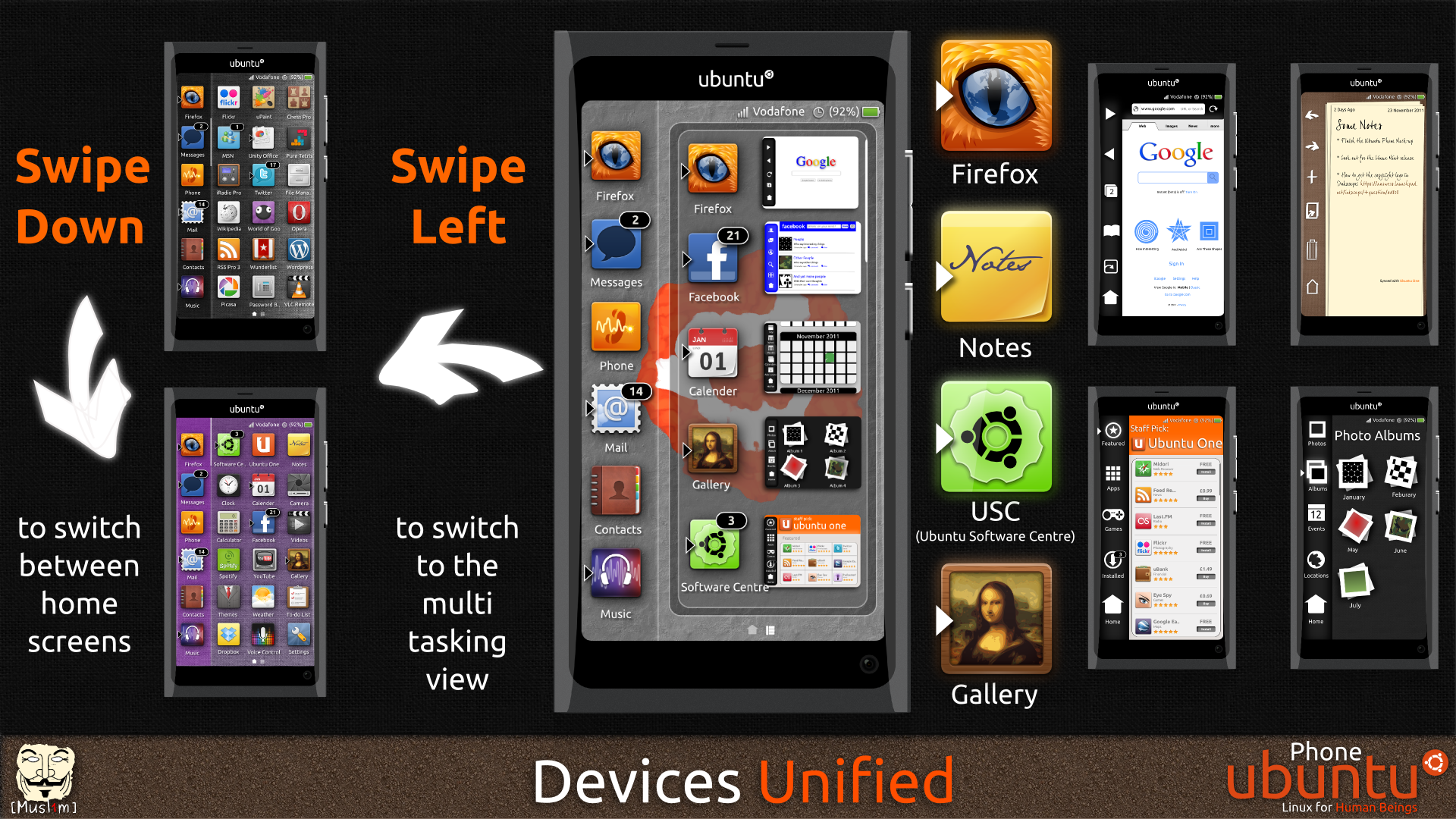
Ubuntu Phone OS Takes A Step Closer?

Ubuntu Phone - Fan Concept
A recent job posting from Canonical appears to show that the company is serious about its intentions to enter the mobile OS market.
In a vacancy titled ‘Business Development Manager (Ubuntu Phone OS), the company are calling for ”a business development lead to engage and develop strong relationships with industry partners in the run up to the launch of Ubuntu as a smartphone operating system,” so as to, they say, “establish a commercial ecosystem around Ubuntu as a smartphone OS.”
With recent announcements (and positive reaction) to Ubuntu for Android, you could forgive Canonical for leaving their ambitions there.
But, if the job posting is taken at face value, they haven’t.
By continuing with plans for a bona-fide Ubuntu Phone OS of their own, they company are putting the ‘Can’ into Canonical.
How well would competing against Android with Ubuntu Phone OS on one tack, whilst also complimenting it with Ubuntu for Android on the other work out? That remains to be seen.
Canonical Jobs, via Tips Form

Saturday, 7 April 2012

How Linux Is Built

You use Linux daily – but do you know how it’s built?
The Linux Foundation explain in this slick 3-minute video.

Saturday, 31 March 2012

April Fools' Day

Origins

Precursors of April Fools' Day include the Roman festival of Hilaria, held March 25, and the Medieval Festival of Fools, held December 28, still a day on which pranks are played in Spanish-speaking countries.

In Chaucer's Canterbury Tales (1392), the "Nun's Priest's Tale" is set Syn March bigan thritty dayes and two. Modern scholars believe that there is a copying error in the extant manuscripts and that Chaucer actually wrote, Syn March was gon. Thus the passage originally meant 32 days after April, i.e. May 2, the anniversary of the engagement of King Richard II of England to Anne of Bohemia, which took place in 1381. Readers apparently misunderstood this line to mean "March 32", i.e. April 1. In Chaucer's tale, the vain cock Chauntecleer is tricked by a fox.

In 1508 French poet Eloy d'Amerval referred to a poisson d’avril (April fool, literally "April fish"), a possible reference to the holiday. In 1539, Flemish poet Eduard de Dene wrote of a nobleman who sent his servants on foolish errands on April 1. In 1686, John Aubrey referred to the holiday as "Fooles holy day", the first British reference. On April 1, 1698, several people were tricked into going to the Tower of London to "see the Lions washed".

In the Middle Ages, New Year's Day was celebrated on March 25 in most European towns.In some areas of France, New Year's was a week-long holiday ending on April 1. Many writers suggest that April Fools originated because those who celebrated on January 1 made fun of those who celebrated on other dates. The use of January 1 as New Year's Day was common in France by the mid-16th century,and this date was adopted officially in 1564 by the Edict of Roussillon.


Other prank days in the world

Iranians play jokes on each other on the 13th day of the Persian new year (Norouz), which falls on April 1 or April 2. This day, celebrated as far back as 536 BC , is called Sizdah Bedar and is the oldest prank-tradition in the world still alive today; this fact has led many to believe that April Fools' Day has its origins in this tradition.

The April 1 tradition in France, Romandy and French-speaking Canada includes poisson d'avril (literally "April's fish"), attempting to attach a paper fish to the victim's back without being noticed. This is also widespread in other nations, such as Italy, where the term Pesce d'aprile (literally "April's fish") is also used to refer to any jokes done during the day. In Spanish-speaking countries, similar pranks are practiced on December 28, día de los Santos Inocentes, the "Day of the Holy Innocents". This custom also exists in certain areas of Belgium, including the province of Antwerp. The Flemish tradition is for children to lock out their parents or teachers, only letting them in if they promise to bring treats the same evening or the next day.
Under the Joseon dynasty of Korea, the royal family and courtiers were allowed to lie and fool each other, regardless of their hierarchy, on the first snowy day of the year. They would stuff snow inside bowls and send it to the victim of the prank with fake excuses. The recipient of the snow was thought to be a loser in the game and had to grant a wish of the sender. Because pranks were not deliberately planned, they were harmless and were often done as benevolence towards royal servants.[citation needed]

In Poland, prima aprilis ("April 1" in Latin) is a day full of jokes; various hoaxes are prepared by people, media (which sometimes cooperate to make the "information" more credible) and even public institutions. Serious activities are usually avoided. This conviction is so strong that the anti-Turkish alliance with Leopold I signed on April 1, 1683, was backdated to March 31.

In Scotland, April Fools' Day is traditionally called Hunt-the-Gowk Day ("gowk" is Scots for a cuckoo or a foolish person), although this name has fallen into disuse. The traditional prank is to ask someone to deliver a sealed message requesting help of some sort. In fact, the message reads "Dinna laugh, dinna smile. Hunt the gowk another mile". The recipient, upon reading it, will explain he can only help if he first contacts another person, and sends the victim to this person with an identical message, with the same result.
In Denmark, May 1 is known as "Maj-kat", meaning "May-cat", and is also a joking day. May 1'st is also celebrated in Sweden as an alternative joking day. When someone has been fooled in Sweden, to disclose that it was a joke, the fooler says the rhyme "April April din dumma sill, jag kan lura dig vart jag vill" (April, April, you stupid herring, I can fool you to wherever I want") for April 1st jokes, or "Maj maj måne, jag kan lura dig till Skåne" (May May moon, I can fool you into Scania) for May 1st jokes. Both Danes and Swedes also celebrate April Fools' Day ("aprilsnar" in Danish). Pranks on May 1, are much less frequent. Most Swedish news media outlets will publish exactly one false story on April 1, for newspapers this will typically be a first-page article but not the top headline.

In Spain and Ibero-America, an equivalent date is December 28, Christian day of celebration of the Massacre of the Innocents. The Christian celebration is a holiday in its own right, a religious one, but the tradition of pranks is not, though the latter is observed yearly. After somebody plays a joke or a prank on somebody else, the joker usually cries out, in some regions of Ibero-America: "Inocente palomita que te dejaste engañar" ("You innocent little dove that let yourself be fooled"). In Spain, it is common to say just "Inocente!" ("Innocent!"). Nevertheless, in the Spanish island of Menorca, "Dia d'enganyar" ("Fooling day") is celebrated on April 1 because Menorca was a British possession during part of the 18th century.[citation needed]

Friday, 30 March 2012

ABOUT EARTH HOUR

Lights out Sydney
2004 - WWF Australia begins to look at new ways to take climate change mainstream after being confronted with serious scientific data
WWF Australia meets with advertising agency, Leo Burnett Sydney to discuss ideas for engaging Australians on the issue of climate change

2005 - A campaign based on hope not fear, and the idea that everyone can take personal responsibility for the future of the planet we live on, is envisioned
WWF Australia and Leo Burnett Sydney start developing the concept of a large scale switch off. The project has the working title, "The Big Flick"

2006 -Leo Burnett is tasked with the challenge of coming up with a campaign name that represents more than simply flicking off lights –Earth Hour is born. The Earth Hour name allows the campaign to broaden the focus from “lights out” to sustainability WWF Australia and Leo Burnett Sydney take the concept of Earth Hour to Fairfax Media asking Fairfax to back the event – they agree Sydney Lord Mayor Clover Moore MP agrees to support Al Gore's An Inconvenient Truth movie is released bringing worldwide attention to the issue of climate change The Stern Report, which discusses the effects of climate change and global warming on the world economy, is released in October. Words of warning for what lays ahead from an economist – not from a scientist - sends a warning to governments globally about the cost of ignoring the threat of climate change


31 March 2007
The inaugural Earth Hour is held in Sydney Australia 7.30pm - 8.30pm, 2.2 million Sydneysiders and 2,100 businesses participate The Intergovernmental Panel on Climate Change (IPCC) releases a report highlighting the risks of rising temperatures, further highlighting the need for urgent solutions
Lightwriting 2010

April 2007
Plans are developed to make Earth Hour a national event in Australia, but international interest is high and cities began signing up to the next Earth Hour campaign


29 March 2008
Earth Hour is held in 371 cities and towns in more than 35 countries globally at 8pm-9pm. A highly conservative estimate concludes that 50 million people participate. This number could have been as high as 100 million people


28 March 2009
Earth Hour held on Saturday March 28 at 8.30pm-9.30pm. Hundreds of millions of people in more than 4,000 cities and towns across 88 countries switched off their lights for one hour, creating a visual mandate for action on climate change effectively kick-starting the world’s first global vote.


July 2009
Earth Hour's Vote Earth campaign releases the Vote Earth symbol calling on citizens of the world to show their vote for Earth over Global Warming.


November 2009
Earth Hour’s Vote Earth launches The People’s Orb, a shimmering silver sphere encasing a 350 gigabyte hard drive with video, images and documents representing the hundreds of millions of people who voted Earth to call for action on climate change. A tangible representation of the voice of the world’s people, The People’s Orb relays from Sydney to Copenhagen in the care of a variety of custodians ranging from former heads of state to iconic rock stars.
Lanterns

December 2009
Global awareness of climate change soars to unprecedented levels during an historic meeting of 192 nations at the UN Climate Change Conference in Copenhagen, Denmark. Vote Earth campaign culminates on 16th December with Earth Hour Copenhagen. The People’s Orb, is entrusted to UN Chef de Cabinet, Vijay Nambiar to be presented to world leaders. The People’s Orb takes centre stage in the plenary on the final day of the conference alongside UN Secretary-General, Ban Ki-Moon, in front of President of the United States, Barack Obama, Danish Prime Minister Lars Løkke Rasmussen, COP President and Climate Minister Connie Hedegaard and over 100 heads of state.


27 March 2010
Earth Hour is held on Saturday March 27 at 8.30pm-9.30pm and succeeds in being a global call to action to stand up, to take responsibility, and lead the global journey to a sustainable future. A record 128 countries and territories take part and iconic buildings and landmarks from Asia Pacific to Europe and Africa to the Americas stand in darkness.


26 March 2011
Earth Hour is held on Saturday March 26 at 8.30pm-9.30pm and continues to break records for participation with 135 countries taking part. Earth Hour 2011 is the first Earth Hour to go beyond the hour, by asking supporters to think about what else they can do to make a difference. Beyondthehour.org is launched to give supporters a place to share stories and pledge to do more.


31 March 2012
Earth Hour 2012 will be held on Saturday March 31 at 8.30pm-9.30pm wherever you are in the world. So save the date and keep coming back to earthhour.org to find out what’s in store.


Thursday, 29 March 2012

75% of Ubuntu Users Also Use Windows (And Other Fun Stats)

Chances are if you’re using Ubuntu you’re a 25-35 year old male living in either the USA or Mexico. 
At least, those are the findings from the recently-conducted ‘Ubuntu User Survey 2012′.
With a response rate of over 17,000, the survey will help Ubuntu developers better understand their user base.
For example, people in Spanish and Portuguese-speaking countries are more interested in buying a pre-loaded Ubuntu device than those in English-speaking countries. Such a stat would be useful to Canonical and/or hardware manufacturers interested in launching Ubuntu-toting hardware.
But what else has the survey revealed?
The ‘average’ age of Ubuntu users is around 25- 35 years old.
And, sticking to the statistics drawn from the survey, are almost certainly male. The number of women who answered the survey was a sub-4% – a figure that looks lower than, in reality, it likely is.
Ubuntu One UsageIt’s good news for Ubuntu One. Despite the cloud-storage service being in competition with titans like Dropbox, over 40% of Ubuntu users make use of it. Quite how many opt into to a paid plan was not part of the remit.
Age breakdown of responses show that the younger you are the more likely (statistically) you are to use it, too.
From Ubuntu’s line-up of burgeoning multi-device future it was Ubuntu for Android (57.4%) that registered the strongest ‘intention to use’. Ubuntu on tablets a reasonable 49.4%, and Ubuntu TV a sizeable (45.7%).
Sounds good – but is there demand? Only a lowly 0.1% of those filling in the survey had bought Ubuntu pre-installed on a device. That’s a very small slice of users, and one that, on the surface, doesn’t exactly scream ‘money to be made’ at potential manufacturers.
So another question was asked: “how likely are you to buy a new device with Ubuntu on it?”. The results this time are encouraging: -
The question of ‘What Other Operating Systems Do You Use?’ threw up a stat I wasn’t expecting (although i’ve never really thought about it): 75% of Ubuntu users also use Windows.
Before the results I genuinely wouldn’t have expected the stat to be that high – I mean, it’s rare to hear a good word said about Windows in the Linux community – but, in reality, the more I think about it the more reasonable it sounds: people use Windows at work, on other devices, for gaming, family PC, etc.
That, and the majority of Ubuntu’s users don’t care about the mythical and philosophical arguments surrounding Linux Vs. Microsoft.
But there is still bully for the Linux-obsessed: over 50% of ‘buntu users also use Android, compared to a pale 13.5% who use Apple’s iOS – a positive sign for Canonical’s plan to marry Ubuntu with Android on mobile devices.
Only 4.2% of respondents said they use no other OS listed in the question.
You can find the full breakdown of stats from the survey here, here and here.